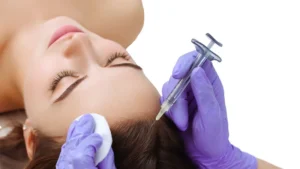
Hyaluronic acid fillers are among the most common aesthetic treatments today. They enable volumization, contour improvement, and harmonious facial proportions with a generally high level of safety and reversibility.
Nevertheless, in practice we also see undesirable results: overcorrections, asymmetrical volumes, palpable nodules, or persistent swelling. In such situations, treatment with hyaluronidase can be beneficial.
However, a realistic understanding is important: the vast majority of filler findings are still assessed clinically – that is, through inspection, palpation, and anatomical experience. Imaging is not standard practice, but rather a supplementary method for selected cases.
What exactly is hylase?
Hyaluronidase is an enzyme that selectively breaks down hyaluronic acid. It is used to partially or completely reduce unwanted fillers.
The effect usually occurs quickly, often within hours to 24 hours.
Typical indications include:
- Overcorrections
- Asymmetries
- Filler migration (e.g. lips)
- local swelling
- Nodules or hardenings
- unnatural contours
- older, structurally problematic filler deposits
It’s important to note that not all fillers behave the same. Depending on the product, depth, amount, and time frame, hyaluronic acid can present itself very differently in the tissue – from clearly defined deposits to completely integrated, barely palpable structures.
Clinical reality: Most fillers are visible or palpable.
A key point in practice is that many filler treatments do not require imaging at all .
In many cases they are:
- visible (contour, volume, light reflection)
- palpable (consistency, knots, irregularities)
- or clinically well-identified through experience
This also means that an “invisible” filler seen on ultrasound is often simply a well-integrated or highly diluted residual finding without clinical relevance.
When ultrasound can be a useful aid
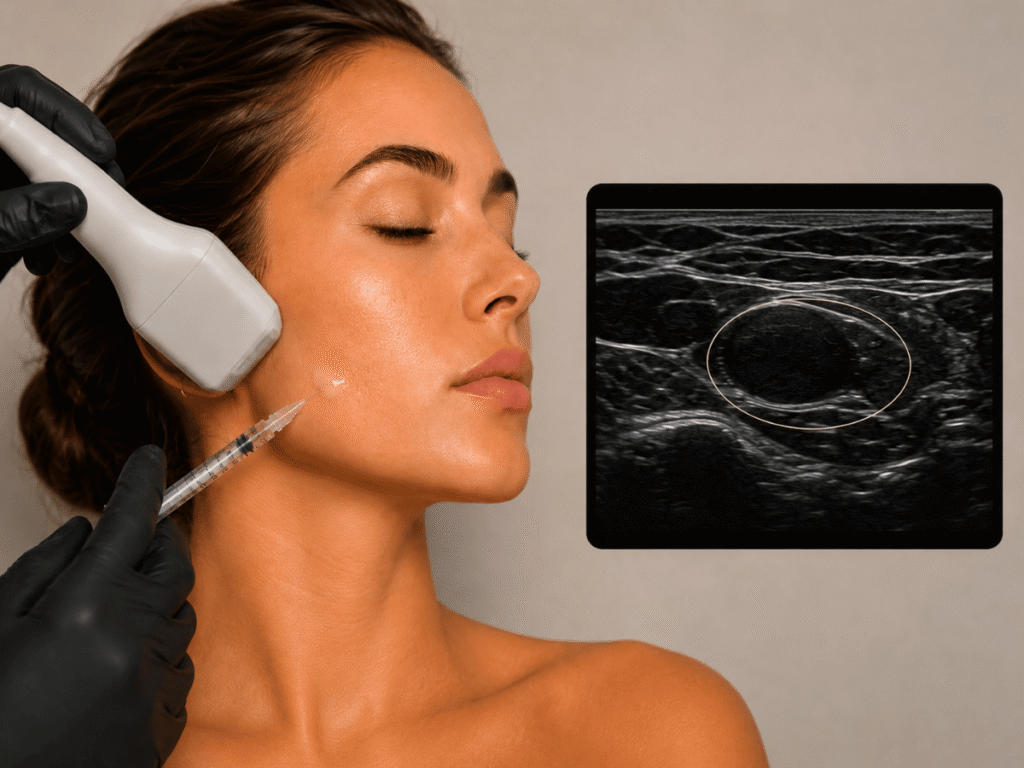
High-resolution soft tissue ultrasound can be helpful in selected situations, especially in:
- fresh or clearly defined filler deposits
- unclear, persistent swelling
- Suspected localized filler deposits
- Differentially diagnostically difficult nodules
- Follow-up examinations after interventions
Imaging can help to better classify structures and treat them more effectively.
However, it remains important to remember: Ultrasound complements the clinical examination – it does not replace it.
Why old fillers are often no longer clearly visible
A common misconception is the assumption that older hyaluronic acid fillers will always remain clearly visible.
In reality, the following happens over time:
- Integration into the tissue
- Decline in structural demarcation
- Change in water binding
- Remodeling through the body’s own processes
This will cause many older fillers to:
- neither clearly perceptible
- still clearly visible in the ultrasound
This does not mean that «nothing is left,» but rather that the substance has adapted so strongly to the tissue that it can no longer be clearly separated from it.
MRI: additional but nonspecific information
In individual cases, an MRI scan can also provide additional information.
Especially in T2-weighted sequences, areas with increased water binding may appear signal-enhanced.
However, the following also applies here:
- MRI does not show specific “fillers”
- but only indirect tissue properties
The interpretation therefore always remains context-dependent.
Hylase is not a universally applicable standard instrument.
Despite all the technical possibilities, hylase remains a targeted medical intervention and not a general «reset instrument».
Especially in:
- long-term inserted fillers
- multiple layered treatments
- diffuse tissue changes
A complete and selective resolution is often not trivial.
Therefore, the following still applies in modern aesthetic medicine:
The best treatment is often the one that doesn’t require overcorrection in the first place.
Conclusion
Ultrasound is a valuable complementary tool in filler correction – especially in the case of fresh, clearly localizable or diagnostically unclear findings.
However, the majority of aesthetic assessments remain clinical: visible, tactile, and experience-based.
Old or well-integrated hyaluronic acid fillers are often neither clearly visible nor easily palpable. This is precisely why the interpretation of findings always requires a combination of clinical experience and – in selected cases – supporting imaging.
Hylase thus remains a precise but indication-dependent therapeutic option, the use of which should always be decided on an individual basis.



 Fragen? Schreib uns oder buche deinen Termin!
 ConceptYOU Clinic, Löwenstrasse 54, 8001 Zürich
 www.concept-you.ch/booking/
 WhatsApp +41 78 231 29 50